Alfred Jensen American, 1903-1981
-
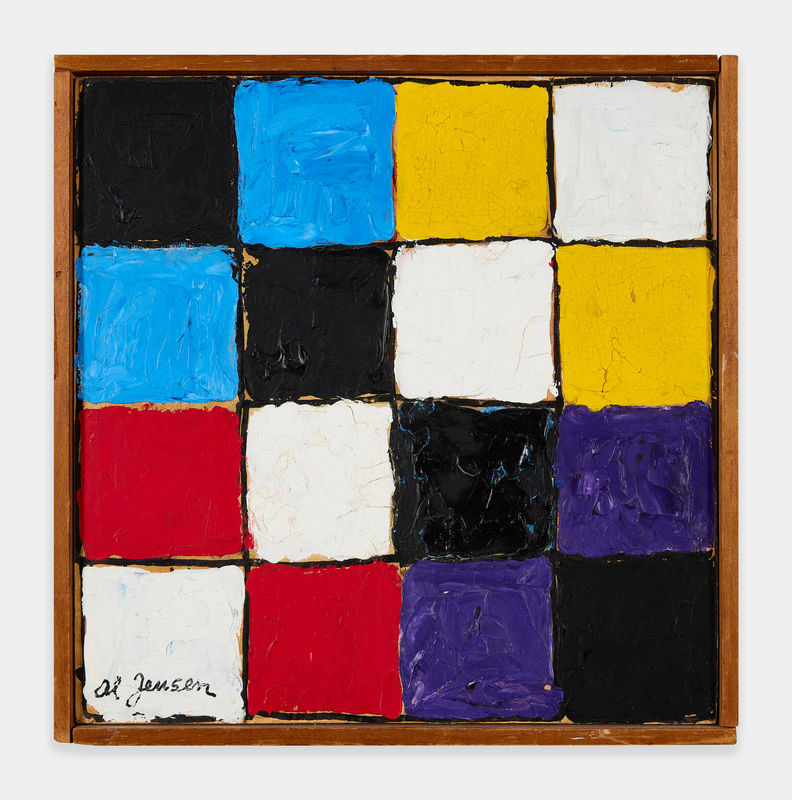
 Warp and Woof, 1955
 -
Magic 14, 1960
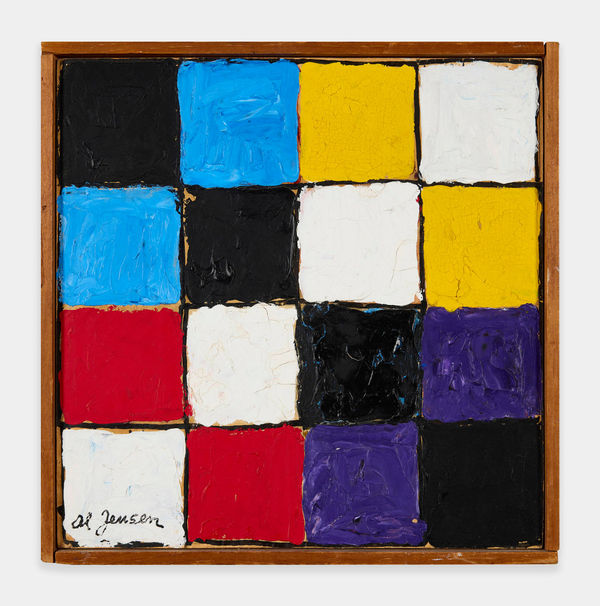
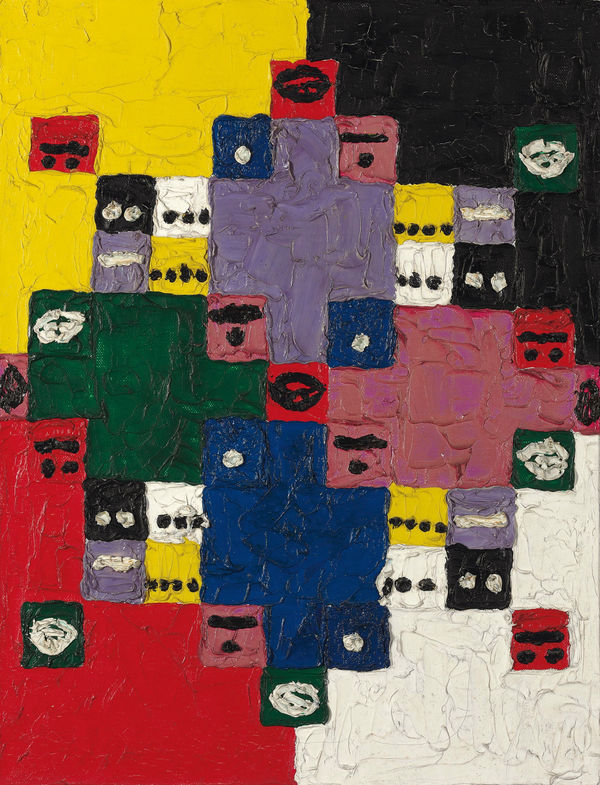

Strongly influenced by Guatemalan textiles and pre-Columbian art, Jensen also drew inspiration from sources ranging from the intuitive to the theoretical and scientific. James Clerk Maxwell’s formulation of electromagnetism and foundational texts like the I Ching, Johann Wolfgang von Goethe’s Theory of Color (Zur Farbenlehre) (1810), and J. Eric S. Thompson’s Maya Hieroglyphic Writing (1960) were key to his art. The Mayan calendar and the Chinese alphabet held special meaning for Jensen and appear in many of his paintings.
Though Jensen’s grids often take on the familiar appearance of games secreting solutions, these works do not serve as maps toward any unified meaning or objective endpoint. While many of the works in Diagrammatic Mysteries have titles that point to their origins, like The Pythagorean Theorem (1964), or symbols with recognizable meanings, as with the arrows in Physical Optics (1975), these psychic footholds only go so far in orienting us within the compositions, which are ultimately guided by essential mystery. As Donald Judd, who himself was inspired by Jensen, observed in 1963, “The theories are important to him and completely irrelevant to the viewer.”
Jensen’s place in contemporary art is perplexing, and, in many ways, he can be viewed as a link between Abstract Expressionism and Pop art. Generationally, he was working in the arena of Abstract Expressionism and was a part of that community. Unlike the Abstract Expressionists’ rejection of Pop art, Jensen developed strong friendships with the next generation. He attended the Happenings and was a fixture at the Pop openings and parties that took over the scene in the early 1960s. The toy store colors and formats suggesting games in his paintings link him to this scene. However, the Pop artists’ denial of surface was completely opposite to Jensen’s embrace of pigment as thick as frosting on cupcakes. His paintings are as comfortable juxtaposed with Adolph Gottlieb’s Pictographs as they would easily blend into their place on the shelves of Claes Oldenburg’s Store. These challenging works, at once accessible and secret, make us realize that Jensen himself is his greatest mystery.
Diagnosed with terminal brain cancer in the late 1970s, Jensen, then one of the stars of the contemporary art world, went into seclusion, and his work disappeared from the scene for decades after his death. Alfred Jensen: Diagrammatic Mysteries is a reawakening of his extraordinary contributions. Jensen has been the subject of various museum retrospectives, including those at the Solomon R. Guggenheim Museum in 1985, Dia Center for the Arts in 2001, and 1978’s traveling retrospective at institutions including the Albright-Knox Art Gallery in Buffalo, New Museum, Museum of Contemporary Art in Chicago, and San Francisco Museum of Modern Art. His work is held in numerous collections throughout the United States and abroad, including the Museum of Modern Art, Solomon R. Guggenheim Museum, and Whitney Museum of American Art in New York; the Los Angeles County Museum of Art; the San Francisco Museum of Modern Art; the National Gallery of Art in Washington, D.C.; the Kunsthaus Zürich and Kunstmuseum Bern in Switzerland; the Louisiana Museum of Modern Art in Humlebæk, Denmark; and the Art Gallery of Western Australia in Perth.